
MjjM Salons Blog
Salon Receptionist Interview Questions: A Preparation Guide
By the MjjM Salons team
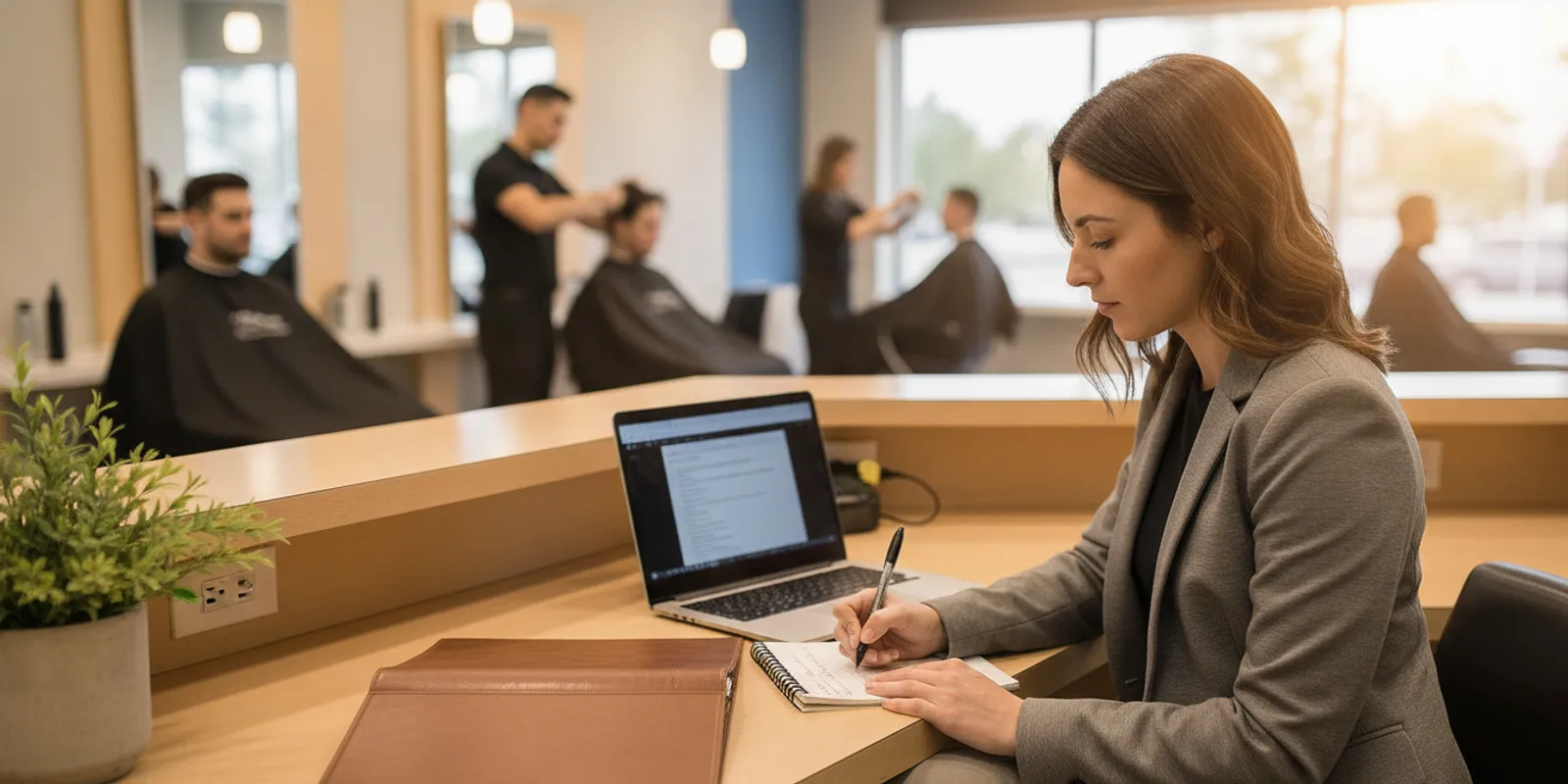
Salon receptionist interview questions help you understand whether a front-desk role fits your strengths and expectations. The interview is also your chance to learn how the employer handles appointments, guest needs, busy periods, training, and teamwork. Preparing specific examples—and thoughtful questions of your own—can help you evaluate the opportunity with care.
Explore salon opportunities and apply directly to MjjM Salons
What does a salon receptionist role involve?
Reception work may include welcoming guests, answering calls, coordinating appointments, sharing approved service information, and keeping the front area organized. The exact duties depend on the employer and the opening. A receptionist may connect guests with stylists or other team members, so a calm and clear approach is useful.
Do not assume that every front-desk job covers the same tasks. One opening may focus on greeting guests and coordinating appointments; another may include checkout or routine administrative work. Ask the interviewer to describe the role’s main responsibilities, which tasks take priority, and how the receptionist coordinates with the rest of the team.
Clarify the work arrangement, too. The job title alone does not tell you how a position is structured. Ask how the role is classified and where you can review the written terms. MjjM Salons describes its career opportunities on its careers page; compare the information there with the details for the specific opening.
How should you prepare for salon receptionist interview questions?
Start with the job posting and build your preparation around its actual requirements. Mark each responsibility or qualification. Beside it, write a real example that shows a related skill. Examples can come from paid work, school, volunteering, or another setting. You do not need to claim salon experience you do not have.
- Identify the central duties. If the posting emphasizes phones, prepare an example of clear communication. If it emphasizes organization, think of a time you tracked details, appointments, or deadlines.
- Choose a few flexible examples. Prepare one story about helping someone, one about managing competing demands, and one about correcting an error or learning a process. A strong example can address several questions when you explain the relevant part clearly.
- Use a simple answer structure. Briefly explain the situation, describe what you did, and share the result or what you learned. Keep the background short and focus on your actions and judgment.
- Review the employer’s own information. Read the current opening and relevant material on the MjjM Salons about page. Use what the employer actually states rather than guessing about a specific role, location, or schedule.
- Prepare questions for the interviewer. Choose a few about duties, training, team communication, and how performance is assessed. These help you judge the work as well as show that you have considered the responsibilities.
- Plan the practical details. Confirm the time, format, location or video instructions, and any requested materials. Allow enough time to arrive or connect without rushing.
Make a one-page note sheet with the posting’s main requirements, your example for each, and the questions you want to ask. For example, if the posting mentions handling calls and appointment requests, note one real situation where you listened carefully, recorded details, and confirmed them. The sheet is a prompt, not a script to read aloud.
Which questions might an interviewer ask?
Interviewers may ask about communication, organization, reliability, judgment, and guest service. The table pairs possible questions with the skill they may explore and a practical way to prepare. These are examples, not a promise that every employer will ask the same questions.
| Possible question | What it may explore | How to prepare |
|---|---|---|
| How would you welcome a guest who has just arrived? | Courtesy and first impressions | Explain how you would greet the guest, listen, and clarify what they need. |
| How do you manage several tasks at once? | Prioritization and organization | Share a real example and explain how you tracked tasks and communicated delays. |
| What would you do if a guest was unhappy? | Listening and judgment | Describe listening, checking the details, staying professional, and following the employer’s process. |
| How comfortable are you answering calls and coordinating appointments? | Communication and accuracy | Be honest about related experience and explain how you verify names, times, and other details. |
| Why are you interested in this role? | Motivation and role fit | Connect your interests and strengths to the duties in the posting. |
| Tell me about a mistake you corrected. | Accountability and follow-through | Choose a genuine example, describe your response, and share what you changed afterward. |
- Possible question
- How would you welcome a guest who has just arrived?
- What it may explore
- Courtesy and first impressions
- How to prepare
- Explain how you would greet the guest, listen, and clarify what they need.
- Possible question
- How do you manage several tasks at once?
- What it may explore
- Prioritization and organization
- How to prepare
- Share a real example and explain how you tracked tasks and communicated delays.
- Possible question
- What would you do if a guest was unhappy?
- What it may explore
- Listening and judgment
- How to prepare
- Describe listening, checking the details, staying professional, and following the employer’s process.
- Possible question
- How comfortable are you answering calls and coordinating appointments?
- What it may explore
- Communication and accuracy
- How to prepare
- Be honest about related experience and explain how you verify names, times, and other details.
- Possible question
- Why are you interested in this role?
- What it may explore
- Motivation and role fit
- How to prepare
- Connect your interests and strengths to the duties in the posting.
- Possible question
- Tell me about a mistake you corrected.
- What it may explore
- Accountability and follow-through
- How to prepare
- Choose a genuine example, describe your response, and share what you changed afterward.
How can you shape an answer that sounds clear and credible?
A useful answer is specific without becoming a long story. The interviewer needs to understand what happened, what you did, and how you approached it. Avoid claiming you already know every salon procedure. Instead, show sound judgment and a willingness to learn the employer’s process.
Use a situation-action-result pattern
Suppose you are asked how you handle competing priorities. You might say: “During a busy shift at my previous job, a customer needed help while I was finishing a time-sensitive task. I acknowledged the customer, kept track of what remained, and checked with my supervisor about what should come first. We helped the customer promptly, and I completed the task without losing track of it.” This answer shows communication and follow-through without pretending every workplace uses the same priorities.
If your experience comes from school or volunteering, use it honestly. A group project can show how you organized deadlines. A volunteer role can show how you greeted people or answered routine questions. Briefly explain the setting so the interviewer can see why your example applies.
Answer honestly when you lack direct experience
If you have not used a salon booking system, say so. Then explain how you learned a comparable tool or how you check details when entering information. That gives the interviewer a realistic picture of your starting point and shows that you understand accuracy matters.
If a question describes a situation you have not faced, do not invent a story. Explain the steps you would take: listen, confirm the facts, check the employer’s guidance, and involve the appropriate team member. Make clear where your own authority ends.
How can you answer common front-desk scenarios?
A guest arrives while the phone is ringing
Explain that you would acknowledge the person in front of you while following the workplace’s procedure for calls. You might greet the guest and use the salon’s established method to manage the call, rather than declaring that one person always takes priority. If the situation becomes difficult to manage alone, say you would ask a teammate for help when appropriate.
The point is not to promise a universal rule. Employers may have different processes. Describe calm communication and attention to both people, then ask how the team handles simultaneous requests.
A guest is frustrated about an appointment
Show that you would listen without arguing, confirm the appointment details, and avoid promising a remedy beyond your authority. You could explain that you would check the information, clarify what the guest needs, and follow the salon’s process for involving the right team member. If you have a real example from another service setting, describe what you did and what happened.
Avoid offering a specific refund, discount, or rescheduling promise as if it were yours to make. The interviewer is likely interested in your judgment and professionalism, not in decisions that belong to someone else.
You notice an appointment detail may be incorrect
Describe checking the information against the appropriate record and correcting or escalating it according to the employer’s procedure. Explain how you would communicate any confirmed change to the people who need it. A careful answer shows that you understand how an entry error can affect both a guest and the team.
You do not know the answer to a guest’s question
It is better to verify than to guess. Tell the interviewer you would be courteous, explain that you want to confirm the information, and ask the appropriate colleague or consult an approved source. Do not speculate about service details, timing, or policies. This helps avoid misleading the guest and gives you a chance to learn the correct answer.
What should you ask about duties, training, and the team?
Use the interview to understand the work rather than relying on the title alone. Ask open, practical questions and listen for concrete answers. Choose the ones that matter most to your decision.
- What are the main responsibilities during a shift?
- How much of the role involves greeting, calls, appointment coordination, or administrative work?
- What training is provided for scheduling tools and workplace procedures?
- How does the receptionist coordinate with stylists and other team members?
- Who can the receptionist consult when a guest request falls outside the role?
- How are schedules, shift changes, breaks, and time-off requests handled?
- What does the employer consider strong performance in this position?
- What are the next steps in the hiring process, and when should a candidate expect an update?
Use the answers to understand the role’s daily rhythm. If the position involves many calls, ask what tools and training are provided. If coordination with stylists is central, ask how the team shares appointment information and resolves scheduling questions. Review the MjjM Salons locations page if location information will help you assess the commute, and confirm the location for the specific opening.
If you need to direct a general question, use the MjjM Salons contact page. For application information, consult the application page. Follow the instructions in the current posting; a general page may not describe every opening.
How can you compare a receptionist opening with other salon work?
First, confirm that the vacancy is actually a receptionist role. Salon employers may recruit for several kinds of work, and a front-desk position is not interchangeable with a stylist or cosmetologist opening. Compare the stated duties, work arrangement, schedule, training, and written compensation information rather than inferring terms from a general employer description.
Ask what tasks are included, who provides training, whether the schedule is fixed or variable, and where you can review the terms. If the interviewer cannot answer a question at that point, ask when and how it can be confirmed. Review written details before deciding whether to accept.
Consider the work you want to do day to day. A front-desk role may suit someone who enjoys organizing details and supporting guest interactions. A licensed professional role has different responsibilities and qualifications. Do not assume the same vacancy, work arrangement, or schedule applies at every location. The careers information can help you learn about opportunities, but check each opening individually.
What should you verify before accepting an offer?
If you receive an offer, compare it with what you learned in the interview. Confirm the job title, primary duties, reporting relationship, work location, expected hours, and start date. Ask how schedule changes are communicated and whether there are written policies to review before your first shift.
Make sure you understand the compensation terms and when they take effect. If benefits are mentioned, ask which apply to this position and where to find eligibility information. Do not treat a general careers page or an informal conversation as a substitute for the actual written offer.
Request clarification about anything vague. For example, “The posting mentions a flexible schedule. Could you explain what that means for the shifts this role covers?” is more useful than assuming flexibility means a particular number of hours or days. Keep your questions factual and note the answers so you can compare opportunities accurately.
You can also ask what support is available during the first weeks. Find out who will show you the systems, how to ask questions during a shift, and how the employer will communicate expectations. Clear onboarding details can help you decide whether you will have the information needed to start confidently.
For general information about employment standards, consult the U.S. Department of Labor. For questions about the terms of a specific offer, ask the employer for the relevant written information and seek qualified guidance when needed.
Review current openings and apply directly to MjjM Salons
How should you prepare on interview day?
Before leaving or joining a video call, review your notes and the job posting. Keep your examples short enough to remember, but do not memorize a script word for word. A conversational answer is easier to adapt when the interviewer asks a follow-up question.
Bring or have access to the materials the employer requested. A resume, a short list of questions, and notes about relevant examples can be useful. For a remote interview, check the meeting link and audio setup ahead of time. For an in-person meeting, confirm the address and plan your route using the instructions provided.
During the conversation, listen to the whole question before answering. Pause briefly if you need time to think. Ask for clarification when a question is unclear. If you do not know something, say so and explain how you would find the correct information. These habits offer a realistic sample of how you may communicate at work.
At the end, thank the interviewer and confirm the next step and expected timing. If you have not heard back by the timeframe they gave you, a concise follow-up through the channel they specified is appropriate. Keep it professional and avoid sending repeated messages across several channels.
Frequently asked questions
Do I need salon experience for a receptionist interview?
Not necessarily. Read the specific posting to see what it requires. If you have not worked in a salon, use genuine examples that show communication, organization, reliability, and sound judgment. Be clear about which skills you bring and which procedures you would need to learn.
What should I bring to the interview?
Follow the employer’s instructions. A resume, a few prepared questions, and examples relevant to the role can be useful. For a remote interview, confirm that you have the meeting link and a working audio setup.
How do I answer a question about handling an upset guest?
Give a realistic example if you have one. Explain how you listened, stayed professional, checked the details, and sought an appropriate resolution. If you have not faced that situation, describe the steps you would take without claiming authority you do not have.
Can I ask about schedule and compensation?
Yes. Ask respectfully about the expected hours and how compensation is structured. Review written information carefully and request clarification about anything unclear before making a decision.
What if I have never used the salon’s scheduling system?
Be honest. Explain how you have learned other tools or kept information accurate in another setting, then ask what training the employer provides for its system and procedures.
Apply directly to MjjM Salons for current opportunities
With preparation, honest examples, and clear questions, you can use the interview to understand the receptionist role and decide whether its expectations fit your experience and priorities.