
MjjM Salons Blog
Hair Salon Apprenticeship Programs Maine and New Hampshire
By the MjjM Salons team
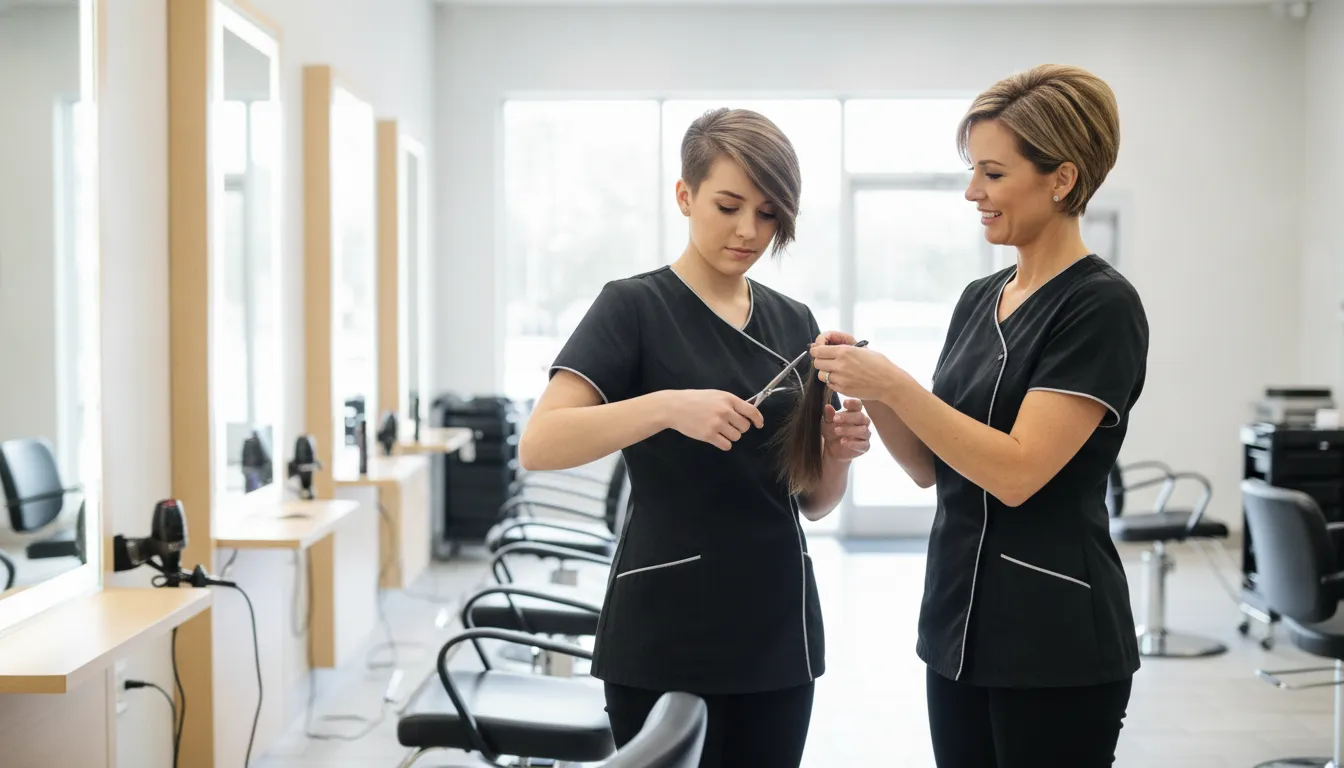
Finishing cosmetology school is an important milestone. But it may not answer your next question: how do you turn classroom skills into a salon career while meeting state requirements? If you are comparing hair salon apprenticeship programs maine and new hampshire. Start by separating three paths: a state-regulated trainee route, a licensed cosmetology school, and an employer's new-graduate onboarding program.
Quick answer: Maine has a defined trainee route with filing, supervision, and hour requirements. New Hampshire candidates should confirm the current process with the state board. A salon's onboarding program can provide paid training, feedback, and practical support, but it does not automatically replace licensing education, trainee registration, examinations, or other state requirements. MjjM Salons recruits new stylists across Maine, New Hampshire, and Massachusetts and offers a structured workplace environment for candidates to evaluate.
That distinction matters because the word "apprenticeship" is often used broadly in job listings. One employer may mean a formal state-approved arrangement. Another may mean coaching after hire. Before you accept a role, ask which parts of the program are regulated training, which are employer onboarding, and how your progress will be documented. This cosmetology careers guide for Maine and New Hampshire provides broader context for comparing salon roles.
How Hair Salon Apprenticeship Programs in Maine and New Hampshire Work
Hair salon apprenticeship programs in Maine and New Hampshire do not follow one universal rule. A state-regulated trainee or apprenticeship path is tied to the licensing system, while employer onboarding is tied to a company's workplace practices. The state controls whether training hours, supervision, records, and examinations satisfy licensure requirements. The employer controls how it teaches its service standards, schedule, client communication, and daily workflow.
Maine has a defined school route and trainee route
Maine recognizes more than one route for completing cosmetology training. The school route requires 1,500 hours in a licensed school over at least nine months. The trainee route requires 2,500 hours over at least 18 months. Candidates must also complete an approved examination. Review the current requirements in Maine's cosmetology licensing statute rather than relying on a general job advertisement.
A Maine trainee cannot simply begin working and count hours informally. Before training starts, required information about the employer, establishment, start date, and direct supervisor must be filed with the director. The word "trainee" must appear conspicuously on the trainee license. Ask who is responsible for the filing and how you will receive confirmation that the arrangement is properly documented.
Supervision and capacity are also important. Under Maine's trainee rules, limits apply to the number of trainees an establishment or qualified supervisor may oversee. If your employer, location, or qualified supervisor changes, the director must be notified within 10 calendar days. These details make a formal trainee arrangement different from an informal promise that someone will teach you on the job.
New Hampshire requirements should be checked with the board
New Hampshire candidates should verify the current route directly through the New Hampshire Office of Professional Licensure and Certification board forms. Forms and instructions can change. The correct process may depend on whether you are applying through school, trainee experience, examination, or another recognized path. This article does not assign a specific New Hampshire hour requirement because the board's current materials should control.
When speaking with a salon. Ask which state requirement applies to your situation and whether the salon is offering a formal trainee placement or an ordinary employee training plan. Then compare the answer with current state guidance. A careful employer should be able to explain its role without promising that workplace onboarding automatically creates a license.
For an additional overview before you contact employers, read the guide to cosmetology license requirements in Maine and New Hampshire. The article can help you prepare questions, but it is not a substitute for confirmation from the appropriate board.
School, Trainee Route, or New-Graduate Training: Which Path Fits?
The best path depends on what you need to establish first. School can provide a defined curriculum and a controlled environment for building fundamental skills. A state-regulated trainee route can place supervised work inside a licensing pathway when the applicable state conditions are met. Employer onboarding can help a new graduate apply existing education in a particular salon. These options may overlap, but they are not interchangeable.
| Path | What it can provide | What it cannot establish by itself |
|---|---|---|
| Cosmetology school | Structured instruction, practical exercises, and preparation for applicable licensing steps. | Graduation alone does not guarantee a license. Application and examination requirements still apply. |
| State-regulated trainee route | Supervised salon experience and hours that may count toward state requirements when the arrangement is properly approved and recorded. | An informal job promise is not necessarily a regulated apprenticeship. Hours should not be assumed to count without state confirmation. |
| Employer new-graduate onboarding | Salon-specific coaching, team routines, feedback, and support as a stylist develops confidence. | It does not automatically replace required education, trainee documentation, examinations, or licensure. |
- Path
- Cosmetology school
- What it can provide
- Structured instruction, practical exercises, and preparation for applicable licensing steps.
- What it cannot establish by itself
- Graduation alone does not guarantee a license. Application and examination requirements still apply.
- Path
- State-regulated trainee route
- What it can provide
- Supervised salon experience and hours that may count toward state requirements when the arrangement is properly approved and recorded.
- What it cannot establish by itself
- An informal job promise is not necessarily a regulated apprenticeship. Hours should not be assumed to count without state confirmation.
- Path
- Employer new-graduate onboarding
- What it can provide
- Salon-specific coaching, team routines, feedback, and support as a stylist develops confidence.
- What it cannot establish by itself
- It does not automatically replace required education, trainee documentation, examinations, or licensure.
When school may be the clearest choice
School may be the clearest option if you still need a broad foundation in cutting, coloring, styling, sanitation, consultation, and client communication. A classroom and clinic environment can let you practice fundamentals before you manage the pace and expectations of a working salon. It may also make the training record easier to understand because the school route has a defined structure.
Graduation is not the end of the licensing process. Confirm which applications, examinations, and other steps remain. If you are already a graduate, review how to get a hair salon job in Maine after cosmetology school for practical job-search questions and preparation ideas.
When supervised salon training may fit
A supervised trainee route may suit someone who learns best through repeated practice with direct guidance. It can also provide a closer connection between training and the daily work of a salon. The important qualifier is that the arrangement must meet the applicable state rules. Ask who supervises you, how hours are tracked, what filings are required, and how the salon handles a change in location or supervisor.
Employer onboarding can be valuable after, or alongside, the education and licensing steps that apply to you. It may cover the salon's consultation process, scheduling systems, service expectations, product recommendations, and feedback routines. Those are meaningful career supports, but they are workplace supports rather than a blanket exemption from state regulation. For a specific employer path, explore MjjM Salons career opportunities and confirm which training applies to your situation.
What Should a New-Graduate Salon Training Program Cover?
A useful new-graduate program should turn classroom knowledge into consistent, client-ready work through supervised practice, clear expectations, and specific feedback. The strongest programs explain what a stylist will learn, who provides guidance, how readiness is evaluated, and what happens after the initial training period. Candidates should be able to ask for those details before accepting an offer.
Technical foundations and safe service habits
Training should reinforce consultation, sectioning, foundational cutting, color theory, application basics, blow-drying, finishing, and styling. It should also cover workstation setup, tool handling, product use, sanitation, and general safety practices. The goal is not to rush a new stylist into every service. It is to build reliable habits and make the next skill level clear.
Ask whether instruction includes demonstrations, guided practice, observation, and feedback after a service. A haircut, color service, and styling request may require different levels of support. Find out how the salon decides when you are ready to work more independently and how coaching is documented.
Consultation and client communication
Technical ability is only part of a successful service. A new stylist also needs to ask useful questions, identify the client's goals, explain realistic options, confirm the plan, and respond professionally when an adjustment is needed. Training should model clear communication without pressure. Product or service recommendations should be accurate and relevant to the client's needs.
Ask how the program handles consultations, timing, service recovery, and client feedback. These conversations help a graduate use technical skills in a way that builds trust. They also reveal whether the employer views training as a one-time orientation or as an ongoing development process.
How MjjM approaches early-career development
MjjM Salons describes a paid, five-day Hairstylist Academy for new team members. The company also describes continuing education and a progression that can include Stylist I, Stylist II, Senior Stylist, and Master Stylist roles, with management paths available. Candidates should confirm current terms for the specific opening, location, schedule, and license status.
MjjM operates across Maine, New Hampshire, and Massachusetts. That regional footprint means candidates should ask which location is hiring, who will provide day-to-day coaching, and how state-specific requirements affect the role. Explore MjjM Salons careers for current opportunities, then ask the hiring contact to distinguish the company's onboarding from any state-regulated training.
Explore new-graduate opportunities with MjjM Salons.
Choosing Hair Salon Apprenticeship Programs in Maine and New Hampshire
When comparing hair salon apprenticeship programs in Maine and New Hampshire, evaluate the learning environment as carefully as the job title. A franchise salon and an independent salon may both offer meaningful mentorship. The difference is often in the systems, team size, operating model, and range of support available. Neither structure is automatically better for every stylist.
Compare mentorship and feedback
Ask who answers questions during a busy shift, how often coaching occurs, and whether feedback is tied to specific services or skills. An independent salon may provide close mentoring from an owner or senior stylist when that person has time and interest in teaching. A franchise environment may offer access to a larger team, established procedures, and support beyond one individual.
Look for clear systems and realistic expectations
New graduates often benefit from knowing how consultations, bookings, service timing, sanitation, and client follow-up are handled. Clear systems can reduce the pressure of inventing every business decision alone. They can also make it easier to understand what good performance looks like. Ask how the salon balances consistency with room for the stylist's creativity and professional judgment.
MjjM Salons positions its model around a team environment and development for hair artists. Candidates can use that information as a starting point, then ask for concrete examples: What does the first month look like? Who gives feedback? What skills support movement to the next level? How is continuing education handled? Specific answers are more useful than a general promise of growth.
Ask how advancement is defined
Career growth should be clear enough to discuss. Ask what responsibilities, skills, or performance expectations are associated with each level, who reviews progress, and how often those conversations happen. The company's internal recruitment research identifies lack of career growth as a major reason stylists leave employers. Treat that figure as company research rather than a universal industry statistic. But use the underlying question in every interview: what is the next step, and how will I know I am ready?
For another perspective on entry-level options, review entry-level salon jobs for graduates. Compare the coaching, schedule, service mix, team culture, and advancement explanation for each opening.
How to Evaluate a New-Graduate Salon Program Before You Apply
Use this checklist before applying or accepting an offer. It is designed to separate the state licensing path from the employer's training promise and to help you identify a program that fits your current experience.
- Confirm your current status. Ask whether the opening is for a licensed stylist, a trainee, or a graduate completing another state requirement. Review the state licensing overview, then verify the details with the appropriate board.
- Identify your supervisor. Ask for the name and role of the person responsible for day-to-day guidance. In a formal Maine trainee arrangement, direct supervision and required documentation matter.
- Ask how hours and records are handled. Find out who tracks hours, what records you can review, and what happens if your employer, location, or supervisor changes.
- Clarify pay and training terms. Ask when paid training begins, what activities it includes, how scheduling works, and which terms apply to the specific opening. MjjM describes a paid five-day Hairstylist Academy, but candidates should confirm current details directly.
- Understand feedback. Ask how often coaching occurs, who observes services, and how you will know which technical or communication skill to practice next.
- Discuss progression. Ask what supports movement from an entry role to the next stylist level and whether continuing education is available.
- Check location and schedule. MjjM has opportunities across Maine, New Hampshire, and Massachusetts. Confirm the exact salon, commute, availability expectations, and shift pattern before applying.
A thoughtful hiring conversation should leave you with fewer assumptions, not more. If the role's use of "apprenticeship" remains unclear, ask the employer to put the training structure and licensing responsibilities in writing. That simple step protects your time and helps you compare opportunities fairly.
See current cosmetologist opportunities with MjjM Salons
Frequently Asked Questions
Do I need a cosmetology license to start a salon apprenticeship in Maine or New Hampshire?
Requirements vary by state and training arrangement. In Maine, a trainee must file required employer, start-date, and direct-supervisor information before training begins, and licensure includes applicable training and examination requirements. Confirm the current process through Maine's licensing rules or the New Hampshire board forms.
How long does a hair salon apprenticeship program last?
There is no single timeline across both states. Maine lists 2,500 trainee hours over at least 18 months, while its school route is 1,500 hours over at least nine months. Employer onboarding may have a different schedule and does not automatically replace state requirements. Ask which hours count toward your licensing path.
What skills do you learn during salon apprenticeship training?
Hands-on training may develop cutting, coloring, styling, consultation, sanitation, and communication skills. Ask how the program balances demonstrations, supervised practice, feedback, and preparation for the licensing process. A strong employer should explain how readiness for more independent services is evaluated.
Are there paid new-graduate salon opportunities in New England?
Some employers offer paid training or paid new-graduate roles, but compensation and employment terms vary by opening. MjjM Salons describes paid five-day Hairstylist Academy training for new stylists. Ask when pay begins, what training is included, and whether the position is a formal regulated trainee path or employer onboarding.
What is the difference between cosmetology school and an apprenticeship?
Cosmetology school provides structured instruction in a licensed educational setting. A state-regulated trainee path emphasizes supervised salon learning and may be tied to licensing hours. Employer onboarding is separate. It can help a new graduate build workplace skills, but it does not by itself waive education, examination, registration, or licensing rules.
Ready to Explore Your Next Step?
If you are finishing cosmetology school or looking for a supported first salon role, compare the licensing path, training structure, supervision, schedule, and growth conversation before you apply. MjjM Salons welcomes candidates interested in building their skills within a team environment across Maine, New Hampshire, and Massachusetts. Apply directly to MjjM Salons to explore current opportunities.